




Liz Truss calls time on leadership, becomes shortest tenured PM
(Alliance News) - Liz Truss has called it quits on her time in No 10 on Wednesday afternoon, drawing the curtains on a disastrous six-week tenure.
Truss announced her resignation after a chaotic 44 days in office during which she lost the confidence of Tory members of Parliament and the public and oversaw economic turbulence.
She is set to become the shortest-serving prime minister in history after she battled an open revolt from Conservatives demanding her departure.
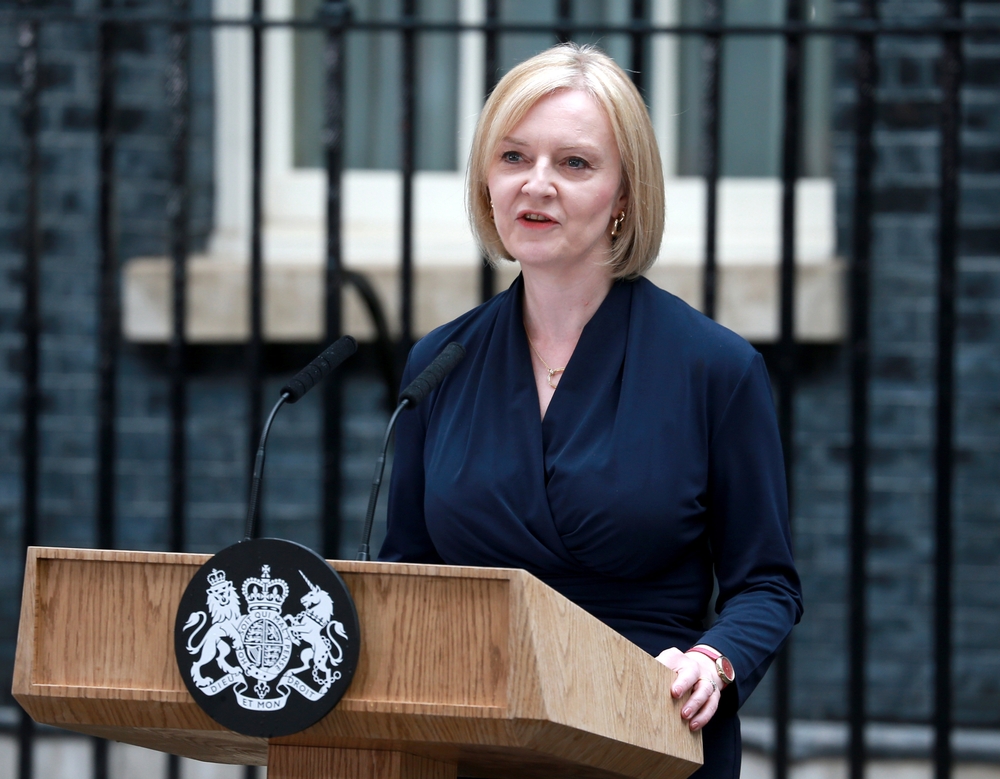
Speaking from a lectern in Downing Street, Truss said she had told the King she was resigning as the leader of the Conservative party as she recognised she "cannot deliver the mandate" that Tory members gave her little over six weeks ago.
"To use a phrase that has no doubt been exhausted in the past few weeks, markets don't like uncertainty. And losing another prime minister in the midst of a cost-of-living crisis is far from ideal," AJ Bell analyst Danni Hewson said.
"But Liz Truss' credibility with markets was shattered when her former chancellor unveiled the mini-budget which effectively lit the touch paper on an explosive period for politics and demonstrated the importance of taking markets with you when it comes to fiscal policy."
Susannah Streeter, senior investment and markets analyst at Hargreaves Lansdown, said: "First her policies went up in flames, then her brief career as prime minister. The great political gamble of Liz Truss has spectacularly backfired but not before wreaking significant damage to the UK economy. It will take considerable time before the risk premium attached to UK assets fades away, following the financial nervous breakdown which followed the mini-budget."
Labour leader Keir Starmer demanded a general election "now" so that the nation can have "a chance at a fresh start".
Without a general election, the Conservatives will be on their third prime minister on the mandate won by Boris Johnson in December 2019.
Starmer said: "The Conservative party has shown it no longer has a mandate to govern."
Sterling got a boost from Truss calling it quits, peaking above USD1.13 briefly. The pound was quoted at USD1.1294 Thursday evening, higher than USD1.1242 at the London equities close on Wednesday.
HL's Streeter noted sterling is highly sensitive to economic policy uncertainty but it has held its gains after Truss leaving.
"Even though the ship Britannia will still be left largely rudderless, with a successor still to be chosen, as far as investors are concerned, the future is marginally brighter without her in charge," she added.
Truss's resignation came just a little over 24 hours after she told MPs she was "a fighter, not a quitter".
But her odds of survival were slashed after chaotic scenes in the Commons followed the resignation of Suella Braverman as home secretary.
The number of Tory MPs publicly demanding Truss's resignation doubled before lunch was over on Thursday, taking the total to 15, but a far greater number were privately agitating for her exit.
Moving ahead, the Conservative party set a high threshold of at least 100 lawmaker nominations for any leadership hopefuls, effectively limiting the race to three candidates - with the early front runners now Boris Johnson, Rishi Sunak and Penny Mordaunt.
AJ Bell's Hewson added: "But can the party really rally behind one person? Can there be a unifying candidate who can heal political wounds and restore confidence that the important business of running the country can actually be put first ahead of political power plays? There are naturally many calls now for a general election, and time will tell whether that can be sidestepped by the incoming prime minister.
"Volatility which has been a hallmark of global markets this year is most definitely here to stay in UK markets, at least for now. Time is short and credibility is on the line, but it is ordinary people's finances that should be the priority."
By Paul McGowan; [email protected]
Copyright 2022 Alliance News Limited. All Rights Reserved.
Related Articles

Gold sparkles and may gleam more as interest rates move lower
(Alliance News) - Gold hit another record high on Friday, and a push to the USD2,600 an ounce mark could...

Marlowe's planned occupational health demerger is "logical evolution"
(Alliance News) - Marlowe PLC's planned demerger of its occupational health division makes sense, German bank Berenberg believes, given the...

Flutter Entertainment deal in Brazil "not a surprise" — Shore
(Alliance News) - Flutter Entertainment PLC on Friday said it has agreed a deal which will see the firm join...